What would happen if a future NetScaler appliance could run small AI models directly in the traffic path?
Not a GPU for training large language models. Not a general-purpose chatbot bolted onto an ADC. I am thinking about a compact, deterministic inference accelerator: something closer to a Groq-style LPU or a purpose-built NPU, designed to make narrow security and traffic decisions with predictable latency.
This is a personal thought experiment, informed by what NetScaler already exposes today. It is not a product announcement, a leaked roadmap or information from Citrix. The question is simply whether the architecture is moving in a direction where local inference would eventually make sense.
NetScaler is already an AI traffic platform
The premise is less speculative than it might sound. Recent NetScaler 14.1 builds already include an AI Gateway layer for managing traffic to language models.
That layer treats AI requests as a traffic-management problem rather than as magic. It understands model endpoints, token consumption, quotas, latency and backend availability. Among the available building blocks are:
- front-end and back-end
aigwprofileobjects; - Azure OpenAI endpoints and backend authentication tokens;
- token quotas, refresh intervals and token accounting;
- token-based rate limiting;
- latency-per-token measurements;
- the
LEASTLLMTOKENLATENCYload-balancing method; - quota-aware spillover through
LLMQUOTA; - content switching based on model routing;
- prompt management and AI Gateway observability.
That is a meaningful foundation. NetScaler is not merely passing HTTP traffic towards an LLM. It is measuring and governing the economics and performance of AI calls.
The next layer is MCP
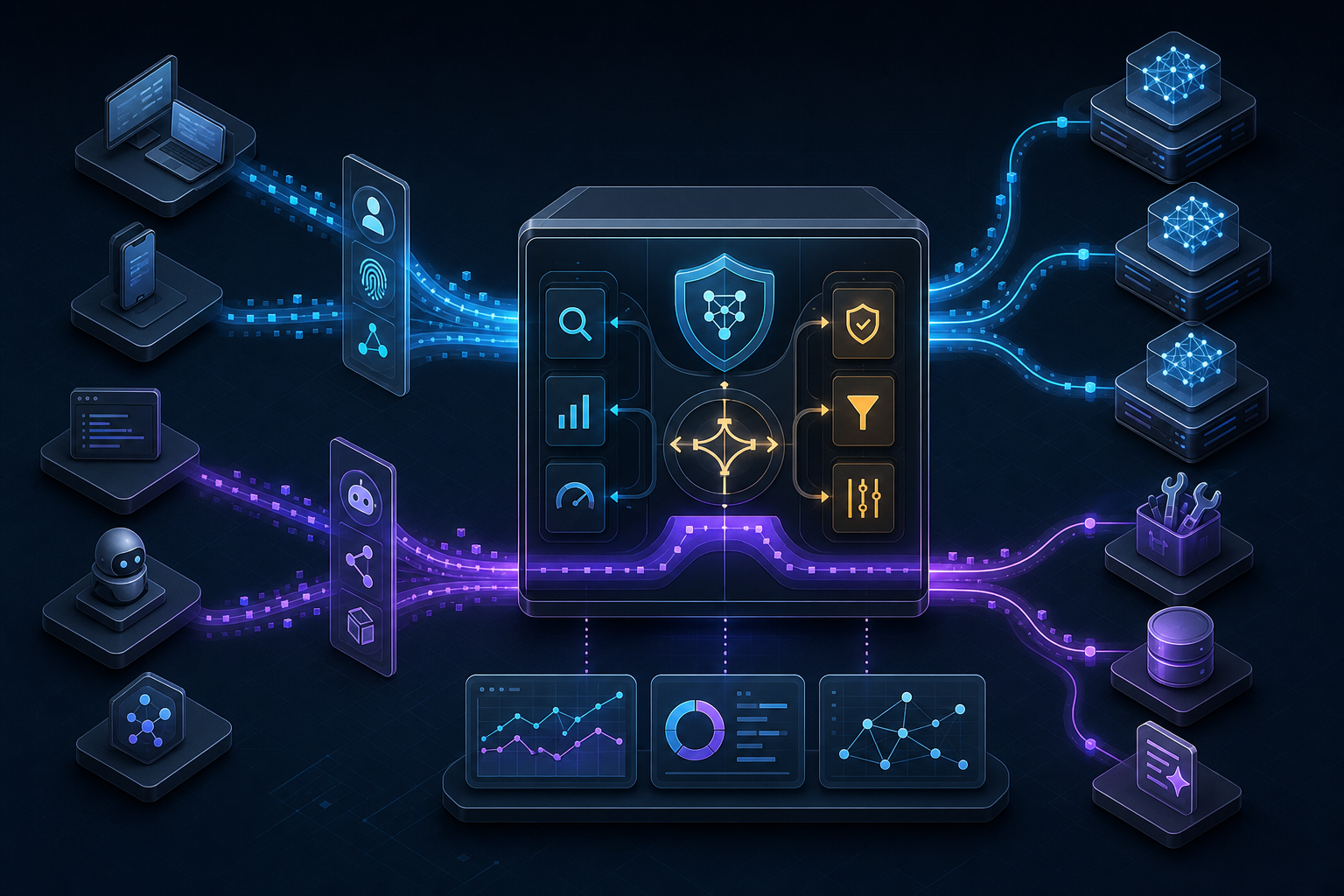
Model Context Protocol makes the idea even more interesting. NetScaler can act as an MCP Gateway in forward-proxy and reverse-proxy designs, placing policy between an AI agent and the tools, resources and prompts it can access.
The platform understands operations such as:
initialize
tools/list
resources/list
resources/read
prompts/list
prompts/get
That creates a familiar ADC role for agentic systems. NetScaler can centralize access to MCP servers, filter tools, apply tool-based rate limits, insert backend tokens and participate in OAuth 2.1 flows. The NITRO API also exposes an mcpprofile configuration object.
In other words, the control plane around AI traffic is already becoming real. NetScaler can sit between clients and models, and between agents and the tools those agents use.
Security is the obvious use case
AI traffic has its own failure modes, but many of them look familiar to an application firewall. Current NetScaler WAF signature sets include LLM-oriented coverage for products such as AnythingLLM, LiteLLM, Figma MCP and Kubernetes MCP.
The relevant threats include:
- command injection;
- server-side request forgery;
- path traversal;
- vulnerable MCP servers and tool implementations;
- unsafe access to backend services;
- prompt injection and attempts to manipulate tool calls.
Today, these protections are primarily signature, policy and routing features. That works well for known patterns. The harder problem is recognizing intent and context when the same request can be harmless in one workflow and dangerous in another.
What NetScaler 15.1 changes
NetScaler VPX 15.1 Tech Preview moves the appliance onto a Linux-based foundation and a data plane built around the BLX and DPDK architecture. The image includes the expected networking components: DPDK libraries, Mellanox mlx5 support, RDMA elements, VFIO support and references to NVIDIA BlueField ports.
Those traces should not be mistaken for proof of an embedded AI accelerator. They are consistent with network offload, flow steering, encryption and packet-processing support. BlueField strings are not evidence that NetScaler is preparing to run an LLM on a DPU.
The important architectural shift is elsewhere:
- Linux replaces FreeBSD for VPX;
- standard Linux diagnostics and lifecycle tooling become available;
- modern driver and hardware support should be easier to evolve;
- PCI passthrough and VFIO fit more naturally into the platform;
- DPDK provides a more direct path to high-speed network acceleration.
The 15.1 image also carries the AI Gateway and MCP-related traffic logic into the new Packet Engine. That makes the platform a stronger candidate for future acceleration, but it does not mean that a local inference chip exists today.
What is not there yet
A search for the usual signs of local model execution does not reveal a complete inference stack. There is no visible CUDA or cuDNN layer, TensorRT, ONNX Runtime, PyTorch, TensorFlow, OpenVINO, NVIDIA GPU driver, Groq runtime or generic NPU framework.
There are CPU capability strings related to neural-network instructions, but those are compatible with ordinary processor feature detection. They do not demonstrate that NetScaler currently runs a model locally.
The accurate description of the product today is simpler: NetScaler understands, routes, measures and protects AI traffic. The models remain external.
Why an inference chip could make sense
A large GPU would be a poor fit for an ADC. It would consume power and memory, require a substantial driver stack and compete with the Packet Engine for resources. Its behaviour under load could also be less predictable than a network appliance wants.
A small, specialized accelerator is a different proposition. A fixed-function security engine, compact NPU or Groq-like LPU could run small models with stable execution time and a tightly controlled memory footprint.
That engine would perform narrow classifications such as:
- detecting unusual API behaviour;
- classifying prompts before they reach an LLM;
- spotting secrets, personal data and likely exfiltration;
- detecting prompt injection and malicious tool instructions;
- classifying bots and automated clients;
- assigning an allow, block, challenge, route or rate-limit decision;
- reducing false positives in WAF policies.
The model would need to stay small, the inputs would need strict limits and the result would need to be explainable enough for an administrator to trust. An ADC processes too much traffic to send every request through a general-purpose language model.
A realistic processing path
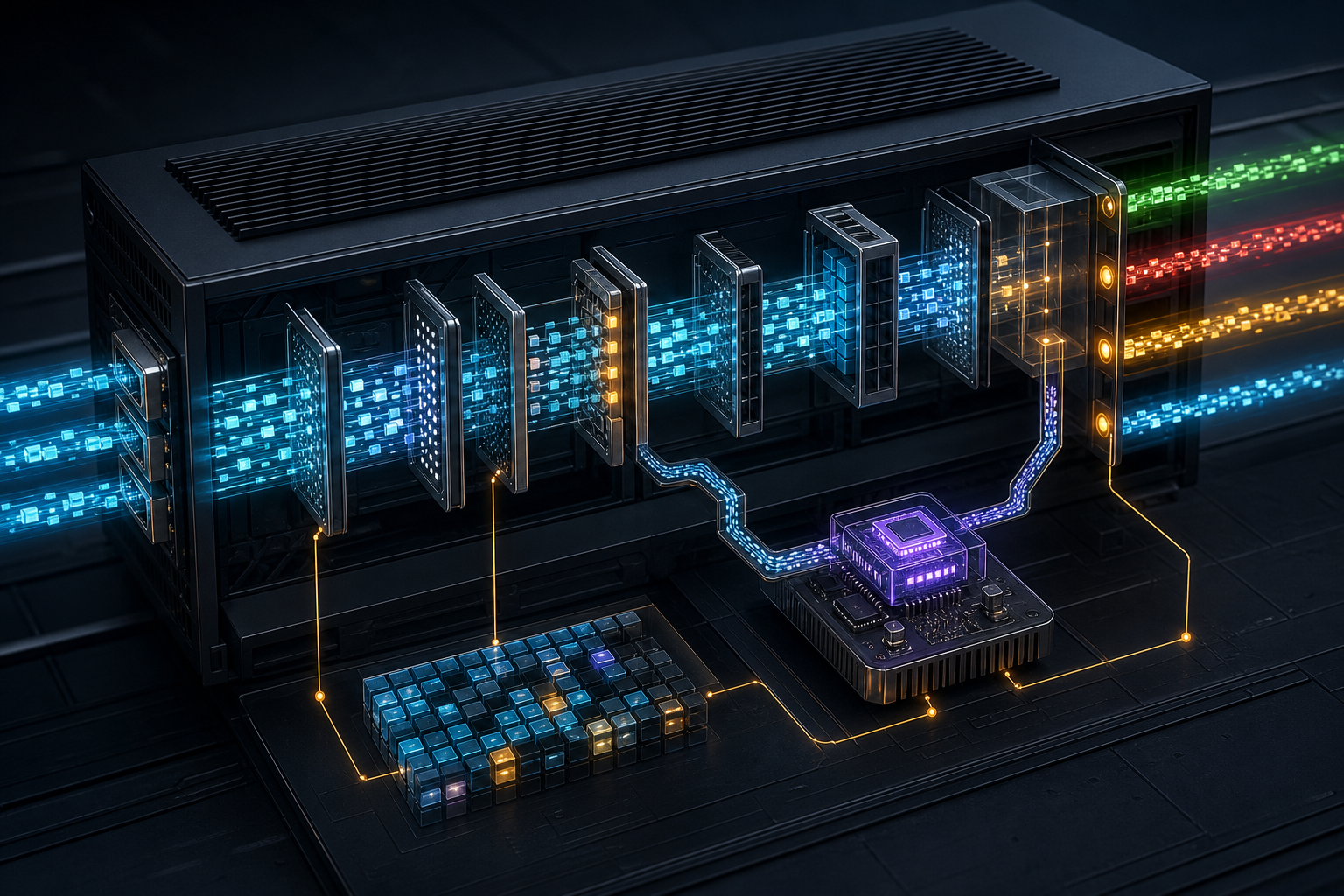
The Packet Engine would still do most of the work. Protocol validation, signatures, reputation checks and conventional policies would eliminate the obvious cases first. Only selected or suspicious traffic would reach the inference engine.
Incoming request
        |
NetScaler Packet Engine
        |
Fast deterministic checks
        |
Selected or suspicious traffic
        |
Small local inference model
        |
ALLOW / BLOCK / CHALLENGE / ROUTE / RATE LIMIT
The result could be cached and reused for a short period. This keeps inference out of the critical path for ordinary traffic while allowing semantic analysis where traditional rules reach their limits.
Three ways this could evolve
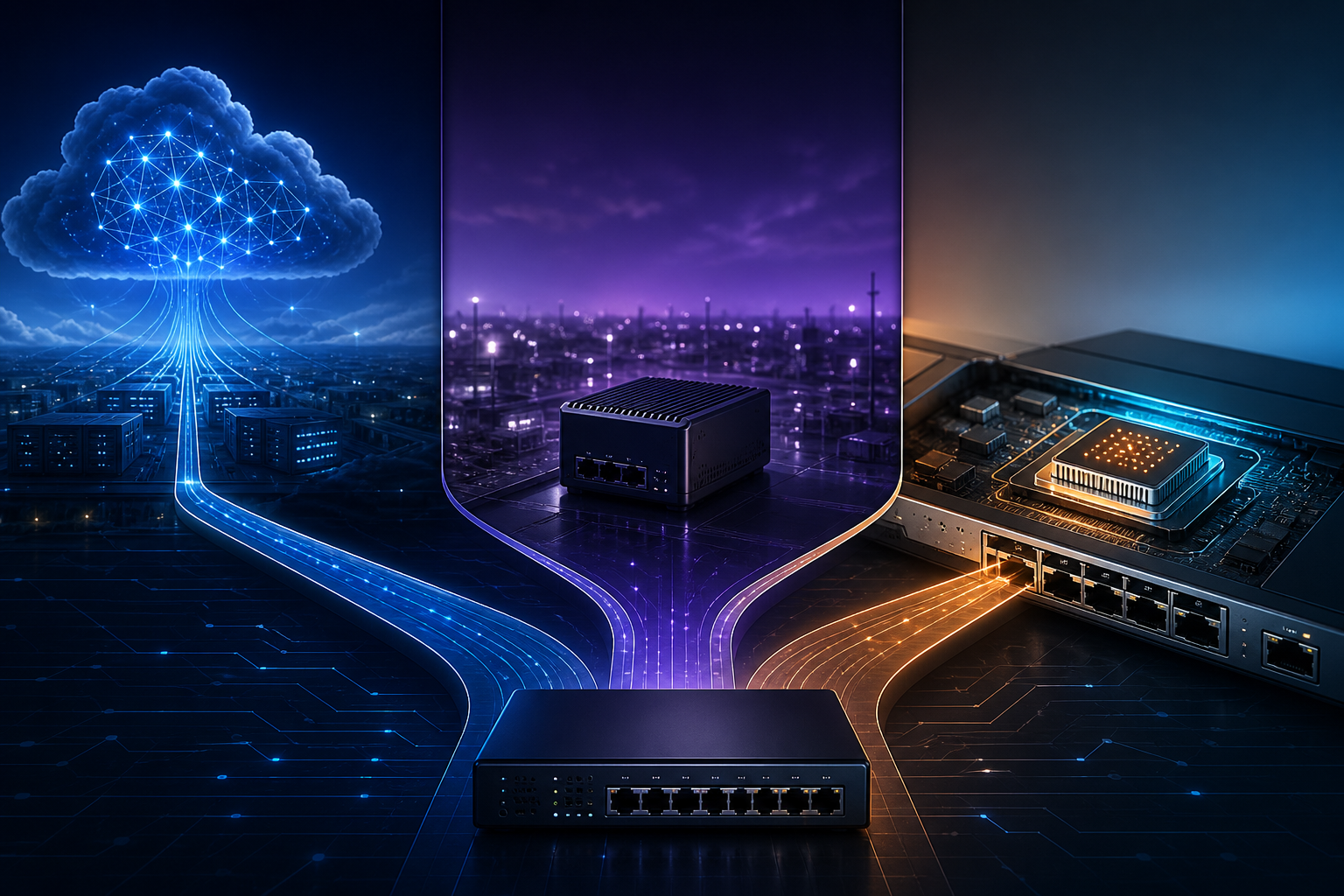
The least invasive option is an external inference service. NetScaler sends selected events or payloads to a nearby model endpoint and applies the returned decision. This is achievable with existing building blocks, but it adds a network hop and creates another service to operate.
The second option is a dedicated inference appliance on the same low-latency network. The Packet Engine stays isolated, while the model runs close enough to avoid a cloud round trip. This is easier to qualify than putting an accelerator inside every ADC, but it introduces a new appliance class.
The most ambitious option is a future MPX or SDX platform combining network acceleration with a small LPU or NPU. TLS and packet processing would remain the job of the networking hardware. The inference engine would make narrowly scoped decisions about suspicious traffic, prompts and tool calls.
That design is technically elegant. It would still require hardware qualification, resource isolation, model lifecycle management, observability, support boundaries and probably a new licensing model. An operating-system migration alone does not make it inevitable.

The case for a NetScaler LPU
The strongest argument is not that NetScaler should become an AI computer. It is that the appliance already owns a strategic position: the traffic path between users, applications, APIs, models and tools.
That position gives it context that an isolated AI service often lacks. It can see the client identity, the route, the backend, the rate, the previous decision and the security policy. A small local model could turn that context into a faster and more precise decision without moving sensitive payloads to another service.
The counterargument is just as important. Inference hardware increases cost and operational complexity. Models need updates, testing, rollback and monitoring. A bad model decision can block a business application just as effectively as a bad WAF rule. Deterministic networking and probabilistic inference do not naturally share the same failure domain.
The verdict
NetScaler does not currently need an AI inference chip to be relevant to AI. Its existing role as an AI Gateway and MCP Gateway is already useful: route the traffic, enforce quotas, measure token costs, protect the interfaces and govern access to tools.
But the architecture also makes a future accelerator plausible. If semantic security decisions become part of the traffic path, a small and predictable inference engine could be a natural extension of the Packet Engine rather than a strange departure from it.
So, what if NetScaler had an AI inference chip?
It would probably not look like a GPU server hidden inside an ADC. It would look more like a tightly controlled security coprocessor: fast, narrow, local and deliberately boring. That is exactly why it could fit.